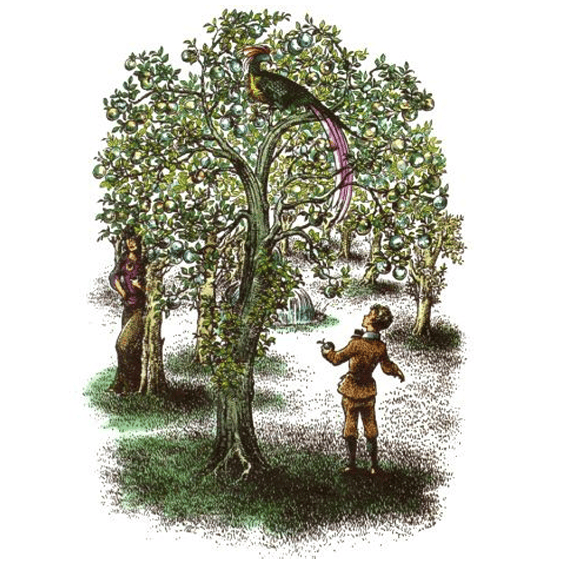
In this chapter, Digory and Polly continue on the quest to retrieve the apple that was set to them by Aslan, carried aloft on Fledge’s back. The new world is beautiful. They are in a cold alpine setting, but soon they sense something quite different.
It was a wonderful ride. The big snowy mountains rose above them in every direction. The valleys, far beneath them, were so green, and all the streams which tumbled down from the glaciers into the main river were so blue, that it was like flying over gigantic pieces of jewelry. They would have liked this part of the adventure to go on longer than it did. But quite soon they were all sniffing the air and saying “What is it?” and “Did you smell something?” and “Where’s it coming from?” For a heavenly smell, warm and golden, as if from all the most delicious fruits and flowers of the world, was coming up to them from somewhere ahead. “It’s coming from that valley with the lake in it,” said Fledge….
Fledge came lower and lower in wide circles. The icy peaks rose up higher and higher above. The air came up warmer and sweeter every moment, so sweet that it almost brought the tears to your eyes.
The smell is coming from an enclosed garden sitting on top of a smooth green hill, surrounded by a wall, with gates facing due East.
As much as each of our conceptions of beauty are conditioned by where we are from, be it mountain or desert or seaside or grassland, the traditional pictures of paradise or heaven or the ultimate lovely place generally are of a warm, tropical place, with life bursting out beyond restraint, with exotic tastes and smells, and the threat of winter banished forever.
In the second book of his Space Trilogy, Perelandra (which is the planet Venus), Lewis has the protagonist, Ransom, visit what is an unfallen world of islands that are covered with tropical vegetation and fruits and which float in a planet-wide ocean of warm, drinkable water. Ransom is tasked with helping the Eve of that world–for it is. indeed, a second Eden–resist the temptations that are being made by another man from Earth who has been possessed by a demon. Through Ransom’s help, the world remains unfallen, leading some commenters to note that another name could be a riff on the great works by John Milton and called Paradise Retained (more from Milton later). Indeed, in accomplishing this, Ransom is a type of Christ.
In the final novel of the Space Trilogy, That Hideous Strength, this is the effect when the goddess Perelandra, or the ruling angel of Venus, comes down to Earth:
Through the bare branches, across the ground which was once more stiffening with frost, a summer breeze was blowing into the room, but the breeze of such a summer as England never has. Laden like heavy barges that glide nearly gunwale under, laden so heavily you would have thought it could not move, laden with ponderous fragrance of night-scented flowers, sticky gums, groves that drop odours, and with cool savour of midnight fruit, it stirred the curtains, it lifted a letter that lay on the table, it lifted the hair which had a moment before been plastered on Merlin’s forehead. The room was rocking. They were afloat. A soft tingling and shivering as of foam and breaking bubbles ran over their flesh. Tears ran down Ransom’s cheeks. He alone knew from what seas and what islands that breeze blew. Merlin did not: but in him also the inconsolable wound with which man is born waked and ached at this touching.
Returning to The Magician’s Nephew, when the travelers come to the gates they find this inscription, and Polly and Fledge understand that Digory must go in alone:
Come in by the gold gates or not at all,
Take of my fruit for others or forbear,
For those who steal or those who climb my wall
Shall find their heart’s desire and find despair.
Digory enters with no fears that he will be tempted to take any fruit for himself, but he does not understand the delectable smell of the fruit, which is later called the Apple of Life and the Apple of Youth. The apple itself is not evil, but taking it for oneself is. He smells the fruit and is immediately tempted to eat it. Later, he will be tempted to take it for another as the rhyme stated, yes, but in a manner that would disobey Aslan. The second temptation is made by the Jadis who has both climbed over the wall and eaten an apple, which causes her face to turn “white as salt” and which stains her mouth. Jadis has made a choice that leads inexorably to her becoming the White Witch.
Serendipitously, I have recently been listening to this amazing podcast which summarizes John Milton’s epic poem Paradise Lost. I learned that in Book IV, when Satan finally makes it from Hell to Earth, he finds that Eden sits atop of a hill (the sides of this hill are not smooth but covered in impassable vines) and that it is enclosed by a wall. It, too, has a gate facing East, but Satan leaps over the wall instead.
So on he fares, and to the border comes
Of Eden, where delicious Paradise,
Now nearer, crowns with her enclosure green,
As with a rural mound, the champaign head
Of a steep wilderness, whose hairy sides
With thicket overgrown, grotesque and wild,
Access denied….
And higher than that wall a circling row
Of goodliest trees, loaden with fairest fruit,
Blossoms and fruits at once of golden hue,
Appeared, with gay enamelled colours mixed:
On which the sun more glad impressed his beams
Than in fair evening cloud, or humid bow,
When God hath showered the earth; so lovely seemed
That landskip: And of pure now purer air
Meets his approach, and to the heart inspires
Vernal delight and joy, able to drive
All sadness but despair….
Now to the ascent of that steep savage hill
Satan had journeyed on, pensive and slow;
But further way found none, so thick entwined,
As one continued brake, the undergrowth
Of shrubs and tangling bushes had perplexed
All path of man or beast that passed that way.
One gate there only was, and that looked east
On the other side: which when the arch-felon saw,
Due entrance he disdained; and, in contempt,
At one flight bound high over-leaped all bound
Of hill or highest wall, and sheer within
Lights on his feet.
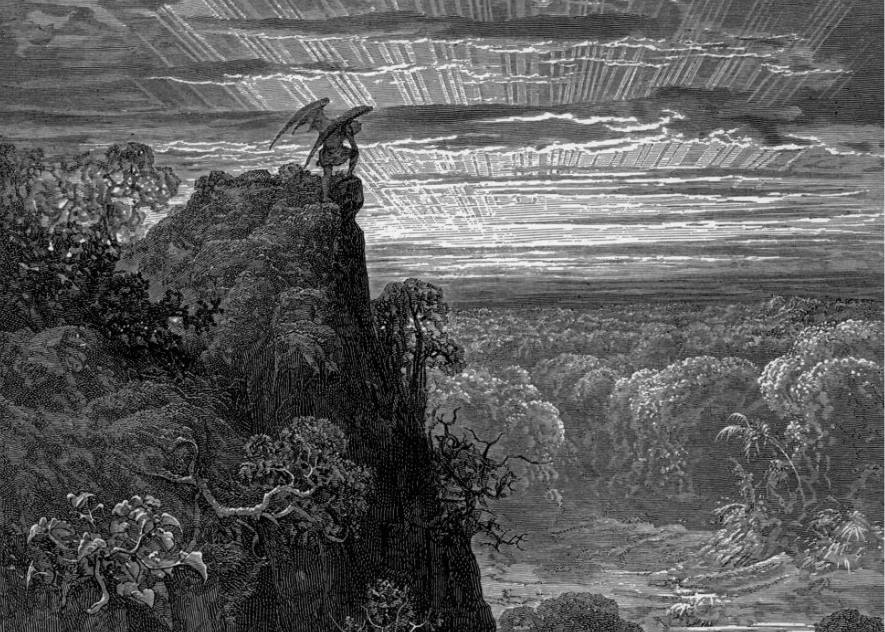
Both of Lewis’ and Milton’s image of a wall leapt over almost certainly allude to Jesus’s words in John 10:1:
“Truly, truly, I say to you, he who does not enter the sheepfold by the door but climbs in by another way, that man is a thief and a robber.”
We know (and experience) all too well the outcome of that tale from our own garden. In Lewis’s tale, Digory sees the Witch and does the most sensible thing, run. It is outside of the garden as he and Polly are about to mount Fledge to make good their escape where the Witch’s strongest temptation is sprung.
“Do you not see, Fool, that one bite of that apple would heal her? You have it in your pocket. We are here by ourselves and the Lion is far away. Use your Magic and go back to your own world. A minute later you can be at your Mother’s bedside, giving her the fruit. Five minutes later you will see the color coming back to her face. She will tell you the pain is gone. Soon she will tell you she feels stronger. Then she will fall asleep—think of that; hours of sweet natural sleep, without pain, without drugs. Next day everyone will be saying how wonderfully she has recovered. Soon she will be quite well again. All will be well again. Your home will be happy again. You will be like other boys.”
“Oh!” gasped Digory as if he had been hurt, and put his hand to his head. For he now knew that the most terrible choice lay before him.
The Witch is not lying, but she is not telling the whole truth. Later we will learn that Digory’s mother would, indeed, have been healed with a stolen apple, but Aslan notes that she and Digory would have come to regret that choice.
This is a temptation that Digory must face alone. Polly does not say anything until he wins through, “She hadn’t dared to say anything all through the argument because, you see, it wasn’t her Mother who was dying.” But even so he is able to withstand temptation by thinking of others. He knows that his mother herself would not approve of him breaking his promise to Aslan and stealing the apple. And, so, the Witch changes her tack and says his mother need never know, that he could leave Polly in Narnia.
That was where the Witch made her fatal mistake. Of course Digory knew that Polly could get away by her own ring as easily as he could get away by his. But apparently the Witch didn’t know this. And the meanness of the suggestion that he should leave Polly behind suddenly made all the other things the Witch had been saying to him sound false and hollow. And even in the midst of all his misery, his head suddenly cleared
The spell is broken, for it was a spell the Witch was weaving as she will later do with Eustace in The Lion, the Witch, and the Wardrobe and which one of her kind will do with Rilian and others in The Silver Chair. Digory wins through temptation, he is obedient, but his immediate reaction is not elation but rather sadness and doubt:
They had started early that morning and what happened in the garden had not taken very long, so that Fledge and Polly both said they would easily get back to Narnia before nightfall. Digory never spoke on the way back, and the others were shy of speaking to him. He was very sad and he wasn’t even sure all the time that he had done the right thing; but whenever he remembered the shining tears in Aslan’s eyes he became sure.
We will see what the compassion from which the shiny tears of Aslan flowed do for Digory in the next post.