Writing about these chapters of The Magician’s Nephew has been challenging. There is so much going on in them philosophically and there are marked shifts in tone.
Though the word “fecundity” primarily refers to the propensity of living organisms to reproduce, there is perhaps no better word to describe some properties of the soil of the new world of Narnia.
Going back to chapter 9 before the animals are created, Digory and Polly and Uncle Andrew are surprised to see that the bar of the lamp post, which Jadis had thrown at Aslan (her last act before she disappears from the story for a long while), is growing into a perfect replica of a London lamp post, complete with a flame. In the next few chapters we will see the soil repeat this magic with gold and silver coins that fall from Uncle Andrew’s pockets and withal a bit of toffee that Digory and Polly intentionally bury to see what happens. The gold and silver pieces grow into gold and silver trees; the toffee grows into a normal, woody tree, but with toffee-flavored fruit.
Upon seeing this effect, Uncle Andrew’s reaction is dream of greed and power:
“I have discovered a world where everything is bursting with life and growth. Columbus, now, they talk about Columbus. But what was America to this? The commercial possibilities of this country are unbounded. Bring a few old bits of scrap iron here, bury ’em, and up they come as brand new railway engines, battleships, anything you please. They’ll cost nothing, and I can sell ’em at full prices in England. I shall be a millionaire. And then the climate! I feel years younger already. I can run it as a health resort. A good sanatorium here might be worth twenty thousand a year. Of course I shall have to let a few people into the secret. The first thing is to get that brute shot.”
Once again, this acquisitive and greedy response to a wonderful new world is very similar to a character in Lewis’s fiction for adults. In the first and third books of the Space Trilogy, the character of Devine is after both wealth and power respectively. In Out of the Silent Planet, his only goal on the planet Malacandra (Mars) is to exploit its resources, for which he is willing to kill its inhabitants.
How do Devine and Uncle Andrew become evil? Are they predetermined to be so or are they so because of their choices? I think Lewis’s views on predestination are rather complex, but he always stresses freedom as the most important value. When did Uncle Andrew choose to go down this path? Most likely this happened while he was trying to gain power through magic.
Whenever the choosing of evil does happen, though, for Uncle Andrew or other of Lewis’s villains, their choices make it subsequently harder and harder to choose the good (though it is never impossible). When Uncle Andrew first hears and sees Aslan, here are his choices:
When the great moment came and the Beasts spoke, he missed the whole point; for a rather interesting reason. When the Lion had first begun singing, long ago when it was still quite dark, he had realized that the noise was a song. And he had disliked the song very much. It made him think and feel things he did not want to think and feel. Then, when the sun rose and he saw that the singer was a lion (“only a lion,” as he said to himself) he tried his hardest to make believe that it wasn’t singing and never had been singing—only roaring as any lion might in a zoo in our own world. “Of course it can’t really have been singing,” he thought, “I must have imagined it. I’ve been letting my nerves get out of order. Who ever heard of a lion singing?” And the longer and more beautiful the Lion sang, the harder Uncle Andrew tried to make himself believe that he could hear nothing but roaring. Now the trouble about trying to make yourself stupider than you really are is that you very often succeed. Uncle Andrew did. He soon did hear nothing but roaring in Aslan’s song. Soon he couldn’t have heard anything else even if he had wanted to. And when at last the Lion spoke and said, “Narnia awake,” he didn’t hear any words: he heard only a snarl.
This dynamic of dulling one’s own spiritual sight until one is blind appears often in Lewis’s writing. Most notably in Narnia it appears in The Last Battle with the Dwarfs who “refuse to be taken in” and only experience kind offers as threats and so cannot enter the New Narnia.
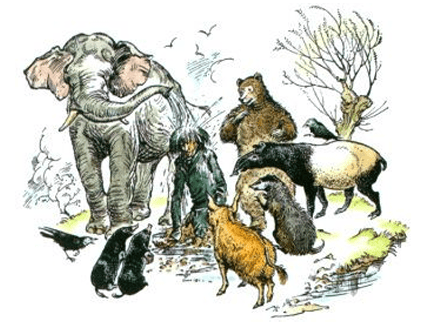
In The Magician’s Nephew, Uncle Andrew experiences a sort of inadvertent physical chastisement as the newly created, innocent animals of Narnia first try to plant him in the ground not knowing if he is an animal and then grow a cage of trees around him to keep him until Aslan can deal with him. They kindly throw all sorts of their own foods into the cage for him-thistles, pears, honey, and more-but this mostly just makes him a sticky mess.
When the children are about to leave Narnia, Polly asks if anything can be done for Uncle Andrew, if Aslan might speak to him. Aslan replies:
“‘But I cannot tell that to this old sinner, and I cannot comfort him either; he has made himself unable to hear my voice. If I spoke to him, he would hear only growlings and roarings. Oh Adam’s sons, how cleverly you defend yourselves against all that might do you good! But I will give him the only gift he is still able to receive.’ He bowed his great head rather sadly, and breathed into the Magician’s terrified face. ‘Sleep,’ he said. ‘Sleep and be separated for some few hours from all the torments you have devised for yourself.’ Uncle Andrew immediately rolled over with closed eyes and began breathing peacefully.”
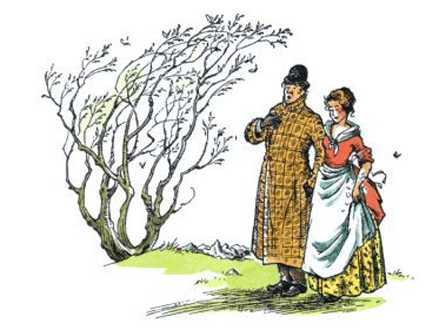
In chapter 11, Aslan begins to mitigate the evil that the arrival of Jadis into Narnia has caused. Because she has come into Narnia by the agency of humans, Aslan determines that humans must be a big part of the solution to put things right. The first thing Aslan does is to ask the Cabby, who he says he has known for a long time, if he would like to live in Narnia always. In our world, the Cabby has had a simple faith in which he has tried his best to deal justly with people and also his horse Strawberry. Aslan calls his wife into Narnia and then inaugurates them as the first king and queen of Narnia.
Aslan’s interactions with Digory in this chapter begin with sternness but are undergirded with deep compassion, but that will have to wait until another post.