THE BELL AND THE HAMMER
THE DEPLORABLE WORD
THE BEGINNING OF UNCLE ANDREW’S TROUBLES
WHAT HAPPENED AT THE FRONT DOOR
THE FIGHT AT THE LAMP-POST
It is a bit of a wonder that Digory and Polly choose to step into another pool in the Wood Between the Worlds to explore an unknown world. But this sense of embracing an adventure that is offered one, of not stepping back in fear, is a quality that is lauded elsewhere in the Chronicles. Indeed, this may be the entire point of The Voyage of the Dawn Treader. And in that book, when the Dark Island appears in the sea in front of the Dawn Treader and most are afraid to venture into the dark seas that surround it, the courageous mouse Reepicheep says:
“But what manner of use would it be ploughing through that blackness?” asked Drinian.
“Use?” replied Reepicheep. “Use, Captain? If by use you mean filling our bellies or our purses, I confess it will be no use at all. So far as I know we did not set sail to look for things useful but to seek honour and adventures. And here is as great an adventure as ever I heard of, and here, if we turn back, no little impeachment of all our honours.”
Several of the sailors said things under their breath that sounded like “Honour be blowed”, but Caspian said:
“Oh, bother you, Reepicheep. I almost wish we’d left you at home. All right! If you put it that way, I suppose we shall have to go on. Unless Lucy would rather not?”
Lucy felt that she would very much rather not, but what she said out loud was, “I’m game.”
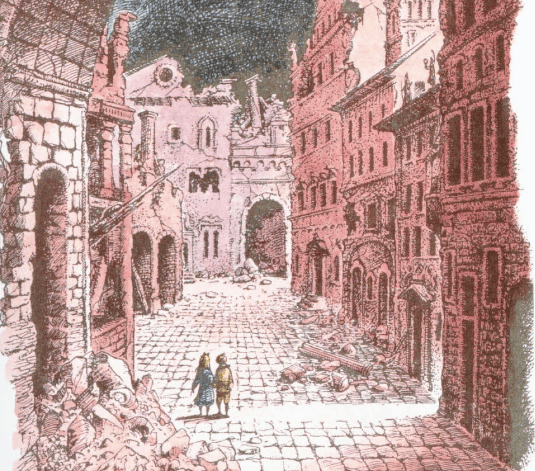
And just as in proceeding toward the Dark Island there was no guarantee of safety, so Digory and Polly have none guaranteed them either as they enter and explore the world in which the ruined city of Charn is located.
One might then justly ask why is the rhyme underneath the bell in the hall of images in Charn not also simply a call to adventure which should be embraced:
Make your choice, adventurous Stranger; Strike the bell and bide the danger, Or wonder, till it drives you mad, What would have followed if you had.
Well, one is warned specifically of danger and there is obviously a sense of enchantment about the bell, which Polly sensibly wants to avoid. Regardless of whether striking the bell is a neutral act or not, though, Digory’s process in coming to do so is clearly wrong as he becomes possessed by the desire to do so, to gain that secret knowledge. The way Polly describes him is illuminating:
“That’s all you know,” said Digory. “It’s because you’re a girl. Girls never want to know anything but gossip and rot about people getting engaged.”
“You looked exactly like your Uncle when you said that,” said Polly.
If there is any ambiguity about his ill-intent, his coercive actions declare his wickedness. He grasps Polly’s wrist, pinning her to himself, and then rings the bell, an action that will have such disastrous consequences. It is a little like the biting of the apple in Eden; it is a little like the killing of Able.
Digory’s actions are a prefiguring of the sort of characteristics they will soon meet in the person of Jadis who is awakened by the bell. Her entire life has been characterized by wanting to have and wield ultimate power. It does seem like she is the worst of a bad bunch, as the series of images of the rulers of Charn reflect a progression into ever greater cruelty.
Yet Jadis is the fiercest (and cruelest) of all as when she was defeated in battle she chose to utter the Deplorable Word, which killed all life in Charn except herself. Thanos has nothing on her.
In Charn Jadis’s power comes from her magical abilities, her physical strength, and her beauty. Uncle Andrew will later be terrified and entranced by her. And even an elderly Digory reflects on her beauty:
The last figure of all was the most interesting—a woman even more richly dressed than the others, very tall (but every figure in that room was taller than the people of our world), with a look of such fierceness and pride that it took your breath away. Yet she was beautiful too. Years afterward when he was an old man, Digory said he had never in all his life known a woman so beautiful. It is only fair to add that Polly always said she couldn’t see anything specially beautiful about her.
Jadis, who very quickly gets labeled as the Witch, loses some of her powers in different places. In the Wood Between the Worlds, she is almost completely powerless. In our world, her magic is gone, but she retains her beauty and strength. In Narnia, it remains to be seen what she powers she will retain.
Another interesting thing in these chapters is the concept of how participating in magic marks one in some way. Jadis looks for these marks in Digory’s face and cannot find them. She sees these marks in Uncle Andrews face. However, she determines that he is not an equal but a very inferior sort of magician and only worthy of being a servant.
I think that the key quality of this sort of magic is the desire to gain power and control over other things and other people. Lewis writings again and again show that he despised any sort of emotional or physical coercion.
In fact, regarding magic, in the Chronicles very few of the good characters perform any. Good magic is mostly the province of Aslan and a few other semi-mystical or semi-divine characters. It is instructive that the one time Lucy utters a spell to gain the power of hearing her friend’s thoughts in The Voyage of the Dawn Treader she is chided by Aslan and her relationship with that friend is forever diminished.
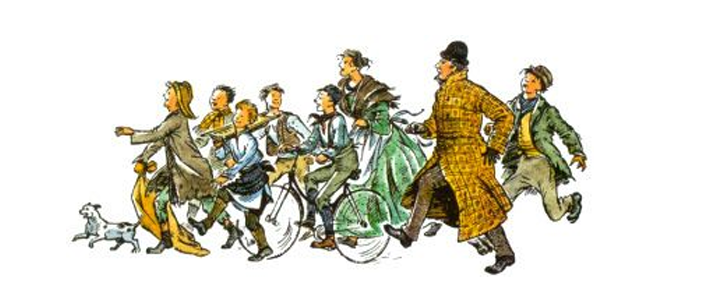
Now, this has been rather a serious post, but chapters 6, 7, & 8 which describe Jadis’s time in our world and the beginning of Uncle Andrew’s troubles and the fight in the street are some of the most humorous in all of the Chronicles. They are a little like the Keystone cops with their slapstick humor. And even though Jadis is still terrifying she is also rather ridiculous and laughed at.
It is all a lot of fun. Before the tone will shift completely in the next few chapters.