
I departed from my ordinary routine and did not rewatch The Spitfire Grill before my movie night several days back. So, despite not being as freshly-versed on the film as normal, it did provide me a viewing experience similar to my guests, none of whom had seen it previously. Trailer | IMDB
One thing that I told the group before the screening was that the film’s release created a minor controversy upon its release in 1996 because it was produced by a small Catholic production company, though picked up by a Hollywood company for distribution. Caryn James wrote in the New York Times that some people were concerned that the film might be proselytizing.
Those at the screening were given a brochure about the film, and in the back was Gregory Productions’ “mission statement,” which explains the company’s intentions to “persuasively move audiences” to appreciate “the values of the Judeo-Christian tradition, in particular, love of and reverence for God.”
“I was sitting in the theater when I read this statement of purpose and my jaw dropped,” said Bingham Ray, a partner in October Films. “It sent a slight chill; that was the collective reaction.”
But in a blue-print of how marketing of grass-roots films works today (minus the powerful arsenal of social media), the producer went on to acknowledge the films potential, too:
In the end, Mr. Ray said that he had decided “film financing is film financing” and that the movie’s spiritual content could be a marketing asset.
“If I were marketing it, I’d start in the middle of the country and create a groundswell, using church groups,” Mr. Ray said. His partners were not as enthusiastic about the film’s commercial possibilities, he added, so October did not pursue it.
It is hard to picture such a landscape now but there certainly were more gatekeepers in those days, it seems, in film and media (not to mention education, government, publishing and other fields).
Today’s entertainment landscape is full of faith-based and faith-friendly entertainment, produced from varying perspectives. Gatekeeping has lost ground in field after field (or has been reconfigured algorithmically or put in the few, but powerful hands of sensitivity readers).For better or for worse, and I think a case can be made for each, postmodernism has won the day and all things are on a more equal footing now.
Technology has facilitated many of these changes. The rise of YouTube, the affordability of DSLRs and mirrorless cameras capable of shooting high quality video (not to mention just iPhones themselves), and the decreasing price of electronics, among many other factors, have all contributed to an almost endless diversity in content creation. And for-profit, crowdfunded streaming platforms have amplified the reach for media catering to different interests. One simply does not need the Hollywood imprimatur quite so much to find success.
Really, though, this mostly just results in the Balkanization of entertainment. Along with the obvious benefits, this also has the lamentable effect that we no longer have much of a shared culture…but, again, perhaps that mythical “shared culture” of yore really only was one that was imposed upon and accepted by minority and sub-cultures. And even majority cultures are not really monolithic either.
________
Whew! We really are a “fur piece” from Gilead, Maine, as the heroine Percy Talbott of The Spitfire Grill might intone in what seems to be a Hillbilly saturated Ohio accent. What about the movie itself?
Well, to give the New York Times its due, its great film critic Janet Maslin pretty much gets things right her brief review. Here is an extended excerpt:
The Spitfire Grill” arrives with a reputation that precedes it….as an inspirational drama initially financed by an order of Roman Catholic priests.
But this contrived, studiously quaint New England tale is less notable for any of that than for the glowing performance of Alison Elliott, its lovely young star….
Ms. Elliott, a former Ford model with a waifish look and a scrappy intelligence, suggests the early Debra Winger in her portrayal of Percy Talbott, a sullen newcomer in a tiny Maine town.
Like Ms. Winger (or Holly Hunter and Jodie Foster, other fiercely self-possessed actresses Ms. Elliott brings to mind), she has a way of commanding vast empathy while seeming to rebuff everyone she meets….
For all its hokum, the film has a wishful decency that does leave its mark. While it proselytizes considerably less than, say, “Phenomenon,” “The Spitfire Grill” espouses some inarguably worthwhile ideas about forgiveness and generosity, and it finds great solace in the beautiful woodland settings where Percy spends much of her time.
Acknowledging her qualifications, that is quite a postive review.
Alas, the screenplay, penned by the creator of Macgyver (go figure), does mostly employ well used plot developments and emotional tropes that pull on the heart strings. But I am hokum-susceptible, as long as it is not delivered with too much contrivance or lack of subtlety. The Spitfire Grill is right on the line for me. With its good characters, small town setting, beautiful scenery, and redemptive arc, it leaves its mark on me as well.
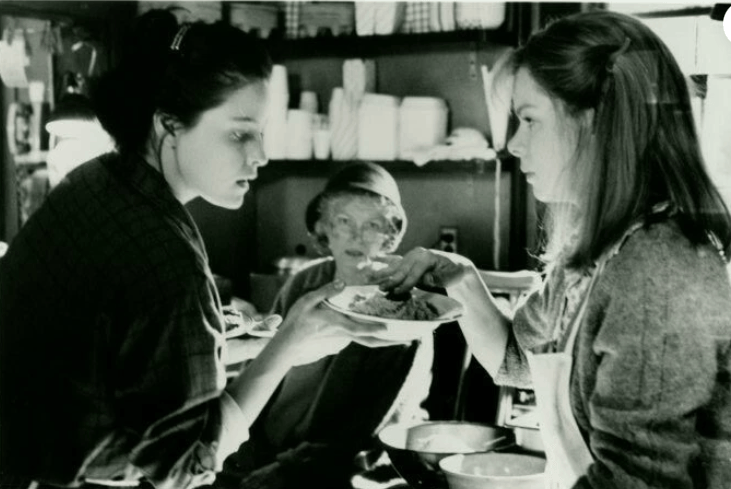
In our discussion after the movie, I articulated that I am drawn to films such as these in which healing and redemption occur in the context of community. Of course in real life, the messy characters are messier and the situations are often intractable and the endings never, ever so tidy.
Do such films help us at all in our actual doing of such hard things in real life? As fundamentally a disappointed optimist, I believe that they do, that the ideals of goodness and beauty do help us foster them in the real, messy world however imperfectly.
What really gets me in this film, though, is the question that is at the heart of this small, tender film, which Percy asks:
“Do you suppose if a wound goes real deep the healing of it can hurt almost as bad as what caused it?”
The film does not really go into the dynamics of this; it may not possess the emotional heft or have the requisite timbre to do so. Percy’s healing does begin, you can see it in the her face and actions, but it is interrupted, one hopes by a healing more complete by far.