
I re-watched Denis Villeneuve’s Arrival twice in the last few weeks, once preparing for a group screening and the other for the screening itself. I was moved each time, especially in the group screening when the volume was turned up loud so as to hear the subtle soundscape in this film with many quiet scenes. Also, I had adjusted my ancient rear projection TV to try to capture the details in the dark portions of the screen. This was essential for this film as Villeneuve employs slow dramatic pans in scenes where there is often very low light, as when Amy Adams’ Louise Banks first enters the alien spaceship which hovers like an enormous graphite monolith above the earth.
Jóhann Jóhannsson’s excellent soundtrack includes a lot of strings in the base register, as well as sounds very like whale song and Tuvan throat singing. It is a masterclass in evoking strangeness, in building up tension as characters enter the unknown and have experiences very close to the numinous. When our protagonists first encounter the aliens, the soundtrack punctuates this with a sound like a fog horn that serves as a sort of aural jump scare.
Unfortunately, Jóhannsson’s work was disqualified for the Academy Awards because of the film’s use of Max Richter’s yearning “On the Nature of Daylight,” in the opening and closing credits of the film as a sort of leitmotif for Louise’s visions of times spent with her daughter, as demonstrated well in this video. Even so, Variety noted that his parts of the soundtrack were a significant achievement:
His original contributions to “Arrival” are noteworthy as part of an increased blurring of the line between music and sound design in film music. For “Arrival,” he told Variety in an interview that he recorded to a 16-track tape loop for a vaguely analog quality, capturing acoustic sounds from cello, piano, and wind instruments, along with vocals.
Of its seven total Academy Award nominations, including Best Picture and Best Director, Arrival won the Oscar for Sound Design.
The two parts of the soundtrack do work well together, but evoke different emotions. They map well with the movie as it intercuts (in increasing regularity) between scenes with Louise and physicist Ian Donnelly communicating with the aliens and vignettes of Louise’s life with her daughter. In this counterpoint structure, Arrival reflects its source material, the short story/novella “Story of Your Life” by Ted Chiang.
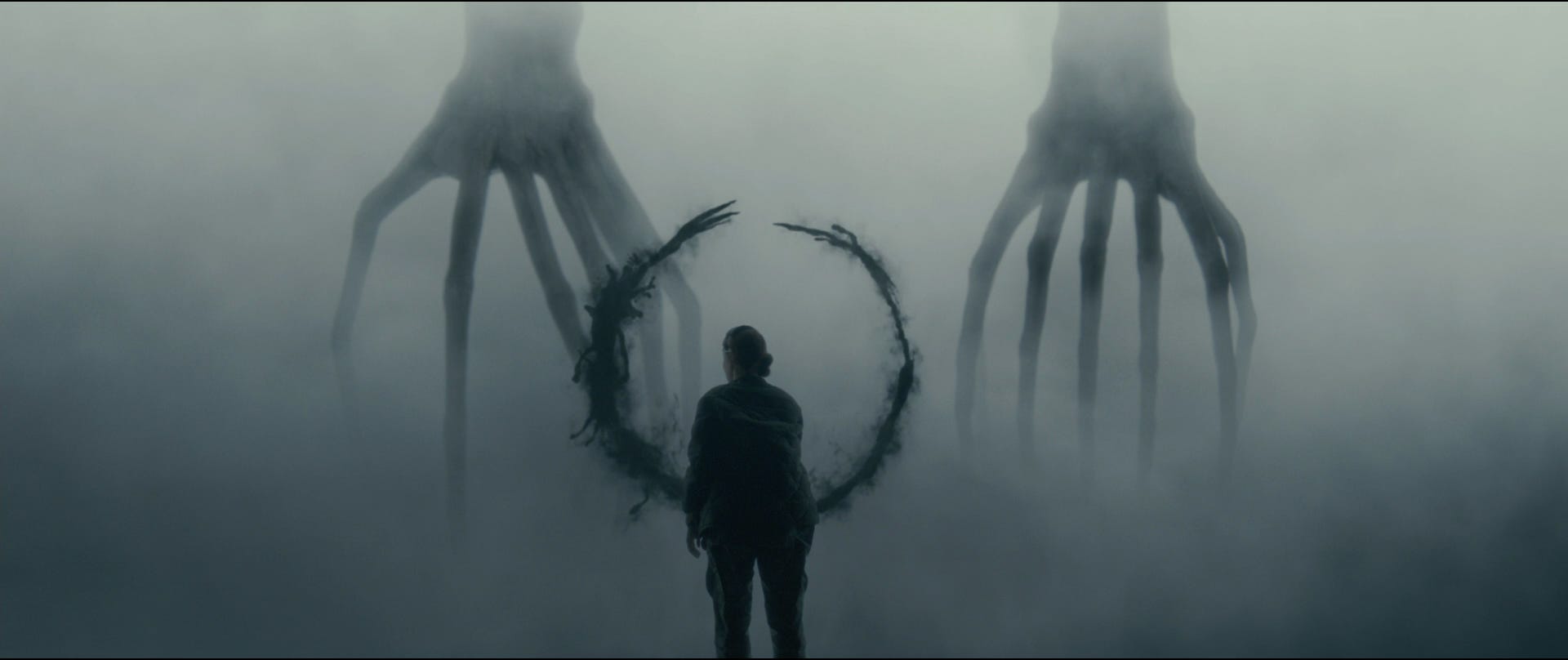
The film was also very worthily nominated for the Academy Award for Best Adapted Screenplay. The screenwriter does add a geopolitical plotline to provide more action and ratchet up the tension, which works for the most part. Also, in the short story, the humans interact with the aliens via numerous glass view screens around the world, while their ships remain in space. Villeneuve lessens the number of view screens and instead situates them inside each of the twelve kilometer-long ships which come down to ominously hover over various parts of the world. Humans must enter these in gravity defying ways to interact with the aliens across huge translucent windows. The aliens appear out of a sort of misty, liquid media on their side of the screen. And when it is discovered that they can write, their semagrams (or logograms) appear as visually stunning circles of ink embellished with variations for different words and phrases. These choices for visual storytelling are stunning.
In both short story and movie, one is told near the outset that Louise’s daughter will have a tragically short life, though the causes of her death are different. Then both follow a similar pattern of interlacing the present day plot with vignettes from Louise’s interaction with her daughter. The interactions in the story are more detailed and have more dialog; the depictions of them in the movie, underlaid with the soundtrack, are perhaps more viscerally impactful, sketching the simple, beautiful moments of life which lead to pain upon the death of a child and the effects this can have on a marriage. Beauty and pain, love and loss, each belongs with each.
The major revelation of both story and movie is how learning the aliens’ language (they are called Heptapods because they have seven appendages) causes a change in Louise’s perception of time. In the story this development occurs some time before the ending; in the movie it serves as the impetus for the denouement, bringing together the disparate threads of plot. As a part of the geopolitical plotline, an alien is wounded while trying to save Louise and Ian. In another added scene in which Louise interacts with an alien on their side of the view screen, we see just how closely she has bonded with them.
And then the aliens leave. In the movie they leave after the resolution of the geopolitical plotline and we are provided a more concrete reason for their visit than in the story. In the novella, no clear reason is given for their visit. Their ships leave from orbit and the view screens are simply seen to be clear layers of silica.
Excursis
It is the disappearance of the alien ships at the film’s end, their “transmutation,” that I am referencing in the word “Upness” in the title of this review. Given the time of year, I have been reflecting on the ascension of Jesus, which appears on the Western church’s calendar on May 14, 2026, though I realize that in these days this is not top of mind of most folks. I have often wondered about the “upness” or upward thrust of it.
9 After he said this, he was taken up before their very eyes, and a cloud hid him from their sight.
10 They were looking intently up into the sky as he was going, when suddenly two men dressed in white stood beside them. 11 “Men of Galilee,” they said, “why do you stand here looking into the sky? This same Jesus, who has been taken from you into heaven, will come back in the same way you have seen him go into heaven.” – Acts 1:9-11
If Jesus was who he said he was (and I believe he was), then surely he knew that heaven was not “up,” indeed, that heaven is not a place in our space-time at all; though most likely to his disciples heaven was certainly up. And, so, as an accommodation to them, the resurrected Jesus, having a fully flesh and blood body again (though one with surprising capabilities), rises in the air and disappears into a cloud.
You must not read that I believe Jesus was an alien–I believe he was fully God and fully man–and yet this depiction of the disappearance of the spaceships in Arrival provides for me satisfying visuals for how the ascension of Jesus may have worked and the awe and wonder it must have engendered in his followers.
In this interview with with Ivan Moran, then of the VFX company Framestore, here is how he describes the task that they were given.
What was the brief from Denis Villeneuve and Louis Morin for the disappearance effect?
The brief was to design a way of having the ships disappear that left the audience with distinct emotions. At this point in the film Louise Banks hasn’t quite solved the riddle of the alien’s language. As we observe the ships leaving, Denis wanted the audience to feel a little melancholic at their departure, yet uplifted and awe-inspired at the sight. Denis and Louis were clear they didn’t want the effect to feel magical or arbitrary, it had to feel somewhat grounded in reality and relatable. We don’t need to know how it is happening this way but we don’t question that it is.

Did you already show this film?
Yes, we watched it last Saturday. Thanks for reading!